

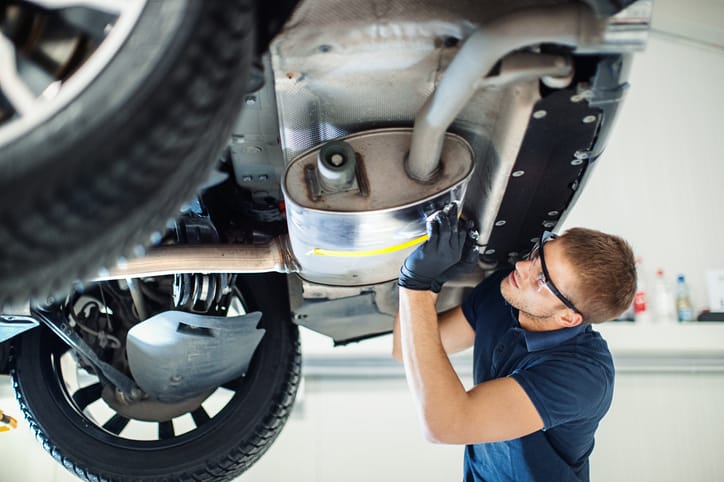
A crucial but often overlooked system in your Mercedes-Benz is the exhaust system. Though perhaps not the most flashy, it is just as important as every other part of your car when it comes to keeping you safe and keeping your car running smoothly.
The job of the exhaust system is to take the toxic gasses produced by your engine, clean them with a catalytic converter, and release them through the exhaust pipe. If your exhaust isn’t working correctly, you may be releasing exhaust fumes that are dangerous to the environment, and in some cases, they can even leak into the cabin of your vehicle.
Because the exhaust system is on the bottom of your car, it is especially exposed to the elements, making it even more likely to break down. In this article, we’ll talk about some of the most common red flags that your exhaust is leaking and what you can do to fix it.
Engine Noises
If your engine sounds conspicuously louder than normal, that may be a sign that you have a break or crack somewhere in your exhaust piping. Generally, people report these noises being especially noticeable when accelerating. If the noises sound like popping, tapping, or hissing, then the problem is likely your exhaust.
Noxious Smell
When functioning correctly, the fumes released by your exhaust should not have much of a smell at all. If your exhaust starts smelling bad, and especially if it smells bad inside the cabin of your vehicle, that’s a sign something has gone wrong.
It’s true that one of the more dangerous gasses your car releases, carbon monoxide, is odorless. However, since your car releases multiple other gasses, smelling those might hint that you are inhaling carbon monoxide and should get your car checked out as soon as possible.
Reduced Fuel Economy
Another symptom of something wrong with your exhaust is if your car starts to get worse gas mileage. More trips to the gas station are not only a strain on your wallet but can also be a sign that your car needs work.
Your engine relies on a carefully calibrated air-to-fuel ratio to maximize your fuel efficiency. If there is a leak in the exhaust, this can change the pressure, or air might escape some sensors meant to keep track of the ratio, leading to an incorrect balance of air to fuel and worse gas mileage.
Adsitco Can Help with Your Repairs
If your Mercedes is having exhaust issues, the best idea is to take it into the shop and let trained mechanics identify and resolve the problem. But when you do so, especially if you drive an older model, it may be difficult to find the replacement parts you need.
That’s where Adsitco comes in. Formed in 1979, we are dedicated exclusively to sourcing and selling parts for Mercedes-Benz vehicles. Our knowledge of the cars you love is unmatched. Contact us today with any questions about how Adsitco can help you with your exhaust repair.